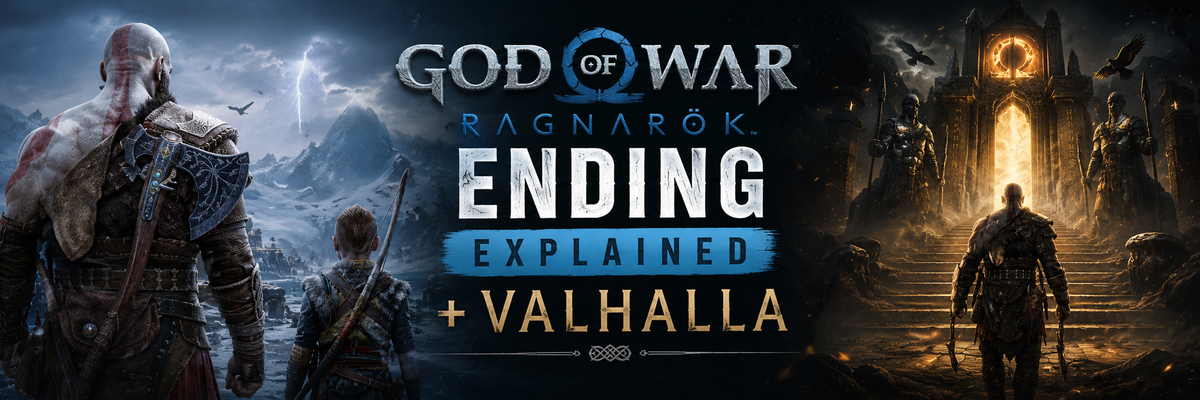
God of War Ragnarök Ending Explained + Valhalla: What the Finale Means for Kratos
A detailed, spoiler-filled explanation of the God of War Ragnarök ending, the downfall of Odin, Kratos' next move, and the Valhalla DLC that further extends the storyline.
Spoilers ahead: The entire story from the God of War Ragnarök ending to the Valhalla DLC will be discussed in this article. Please pause reading here and return once you have finished the base game.
God of War Ragnarök is the last installment in Kratos and Atreus' journey through Norse mythology, and it successfully accomplishes what any good ending must: concluding one conflict, separating a family in an agonizing yet imperative manner, and providing a brighter future for Kratos that he didn't think was possible. The base game initially made its debut on both PS4 and PS5 in November 2022, followed by Valhalla, a free epilogue added in December 2023.
The God of War Ragnarök ending explained
The climax starts off by introducing the last card available in the deck – Ragnarök itself. Kratos and his party will use the horn, Gjallarhorn, to bring about the calamity to make sure the showdown goes down in Asgard. According to the game’s official PlayStation guide, the title is all about Kratos and his son Atreus traveling across the Nine Realms in search of answers for the impending apocalyptic war.
At this point, once the offensive hits Asgard, the question of victory becomes less relevant than how much of an impact it will have and whether anyone survives the fallout. In this scenario, Kratos battles the god Thor, who is given one of the best moments for the series, namely when he offers to make amends and choose a new life for their progeny's sake. The god shows signs of being willing to do so; however, Odin kills him first, thus making his sacrifice all the more meaningful for making the finale decisive.
This finale marks the complete failure of the entire Norse plot arc itself. In what can only be described as an epic struggle, Kratos, Atreus, and Freya work together to defeat Odin in a series of battles. Although Odin is defeated, he still makes attempts to manipulate his way out of the situation at the very end. However, one more opportunity is provided to Atreus to allow Odin to live differently, but he rejects it. Using the Jotnar magic granted to him, Atreus imprisons Odin's soul within a marble he had been accumulating throughout the game. The devastated Sindri destroys that particular marble with the soul, thus ending Odin completely.
It is the death of Brok that makes this ending even more dark. Before this point, the characters had found out that their enemy was not “Tyr” but Odin in disguise, which led to Brok’s stabbing and Sindri going mad with grief and fury. By the time that Odin is dead, Sindri was no longer the orderly dwarf that was seen at the beginning of the game; rather, he had become a figure of rage and sorrow. It is for this reason that the ending was very effective.

What happens to Atreus at the end?
After the destruction of Asgard, Atreus does not follow his father. Rather, he follows the path designed by the giant shrines and sets off in search of the giants. The GamesRadar analysis of the ending claims that the sequence following the ending makes it clear that this quest will take Atreus to a secret shrine where he sees everything as it really happened. This realization encourages him to go off alone. While it hurts Kratos to let his son go like that, he recognizes that this is what Atreus needs.
This final act is probably one of the most perfect embodiments of the theme that defines the game – sometimes, love entails separation. While Ragnarök features gods' murders, it also involves a father teaching himself how to stop crushing his son with fear and the latter figuring out that he can be independent without turning away from his father. This is what Santa Monica Studio was talking about when it said that Ragnarök is a tale about holding on and letting go.
What the ending means for Kratos
Kratos' character evolution is what it's all about. Throughout the Norse mythology games, he feared becoming like the gods of Olympus – cruel, violent, and driven only by power. At the conclusion of Ragnarök, Kratos chooses to do things differently. He defends, guides, and no longer feels obligated to follow the patterns of his old self. The lore surrounding Valhalla confirms this point by noting that Kratos now sees a future where he no longer has to fall into the same traps.
This is why the ending shrine sequence is so important. He finds a mural that redefines his entire life and suggests that his legacy will be something different than the destroyer he used to be. While there is room for discussion regarding its actual interpretation, the underlying meaning is obvious – Kratos is free from the Kratos of the Greek storyline.
The lesson that long-time players should learn from the end of this installment is that Ragnarok did not simply bring the end to the series. Rather, it brought the end of one form of Kratos. This aspect is quite significant because while the end does not put an end to the possibility of future events, it still brings closure to the Norse storyline.

Where Valhalla fits into the story
God of War Ragnarök: Valhalla cannot simply be ignored as another side quest mode. It is an epilogue available for free that continues the narrative after the climactic battle with Odin, the death of Atreus. According to Sony and Santa Monica Studio, it is a personal and introspective adventure wherein Kratos visits Valhalla with Mimir as his sole companion. The idea is to challenge not the world, but Kratos' inner demons – things that he is yet to come to terms with.
However, it introduces a different game structure. Valhalla combines combat elements from Ragnarok with roguelite elements, which means that each run will be a unique journey with a combination of enemy types and different decision-making opportunities. From the official description, it is known that failure does not mean game over for the player as Kratos awakens once again to continue on his journey, taking any assets he gained during previous failures with him.
This aspect is critical because it corresponds with the narrative. It is not enough for Kratos to defeat his enemies. What he must do instead is confront himself. Each iteration, each restart, and each calibration conveys the same message – struggle breeds development, yet he needs to find the courage within him to confront the problem. This is reinforced by the very language used in describing the gameplay mode – mastering mind and body.
Why Valhalla matters after the main ending
Valhalla is important because it provides catharsis for the Kratos we've come to know since 2018. The main game finishes with an optimistic message, but only Valhalla truly deals with Kratos' past experiences. The DLC takes place after the death of Odin, after Atreus' departure, and after Kratos must face the results of his actions. This makes it the epilogue in every way; Valhalla doesn't recapitulate the conclusion, it analyzes it.
In terms of advice, if you want to see Kratos at peace with himself, you should experience Valhalla. According to Sony, it's even advised to do Ragnarok first to prevent spoilers, although the DLC is unlocked immediately after purchasing the base game. Because the expansion is free, there is nothing stopping players from giving it a go, and in the PC version, it is part of the official game.
This expansion shows that the Norse story is not only about bringing an end to conflict; it is about practicing restraint. This is uncommon for a massive action game, but it is what makes Ragnarök unique even in 2026. The game is still available on both the PlayStation and PC, and it is also supported by post-release content like the Dark Odyssey update celebrating its 20th anniversary.

Should you play Valhalla before or after the ending?
Play the campaign mode first. Valhalla was crafted as the epilogue of the game and this is how Sony PlayStation and Santa Monica Studio have presented it. It takes for granted your understanding of what had occurred to Odin, Atreus, and other characters in the game, and it is best experienced by people who are aware of what Kratos has lost and is afraid of losing.
Playing the DLC early on may not affect your gameplay experience since it has been designed to be fun and exciting. However, you would be missing out on its full potential as one of the most reflective pieces of downloadable content in the series if you choose to play it too early.
Final take
What makes the God of War Ragnarök ending successful is its refusal to tie up loose ends in the wrong places. Odin may be defeated, but the loss lingers on in the form of sorrow. Atreus may have been sent away, but their relationship with Kratos will continue. While Freya gets her future and Sindri is left destroyed, Kratos has earned the opportunity to finally change into someone better than what he once was.
In the context of gamers seeking God of War Ragnarok ending explained, one can simply say that the end comes after all the battles of the Norse gods have ended. However, Kratos' journey is just getting started.
FAQ
Is Valhalla connected to the primary storyline?
No. It is a free expansion set after Ragnarok’s conclusion and centers around Kratos’ character development.
Is there a requirement to purchase God of War Ragnarök to access Valholla?
Yes. Though the DLC is free of cost, it requires the base game to be played.
Is God of War Ragnarök still playable in 2026?
Yes. The game can be played on PS4, PS5, and PC, where it also features Valhalla.
For Those interested, here is their God of war merchandise collection:
https://bowchika.in/collections/God of war